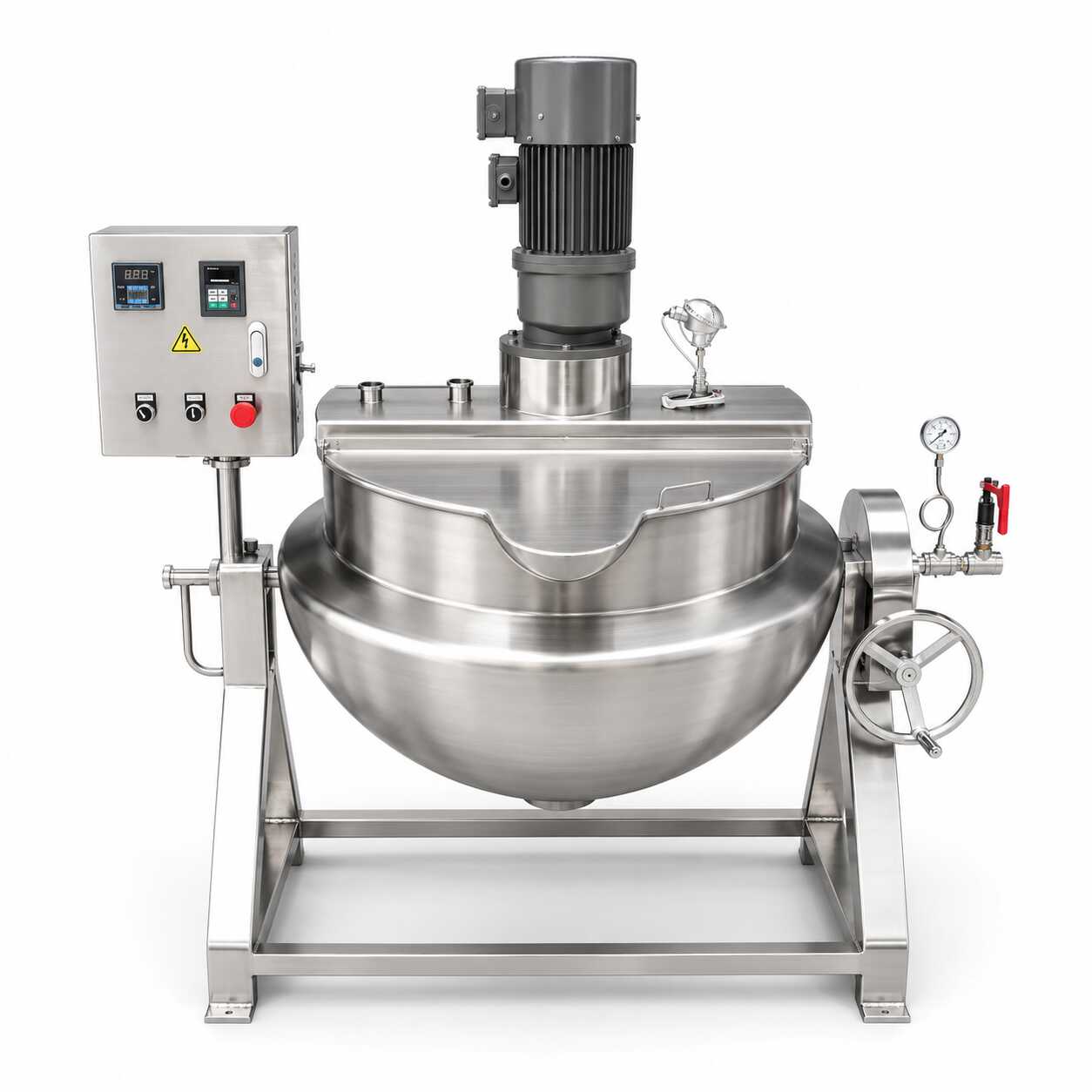
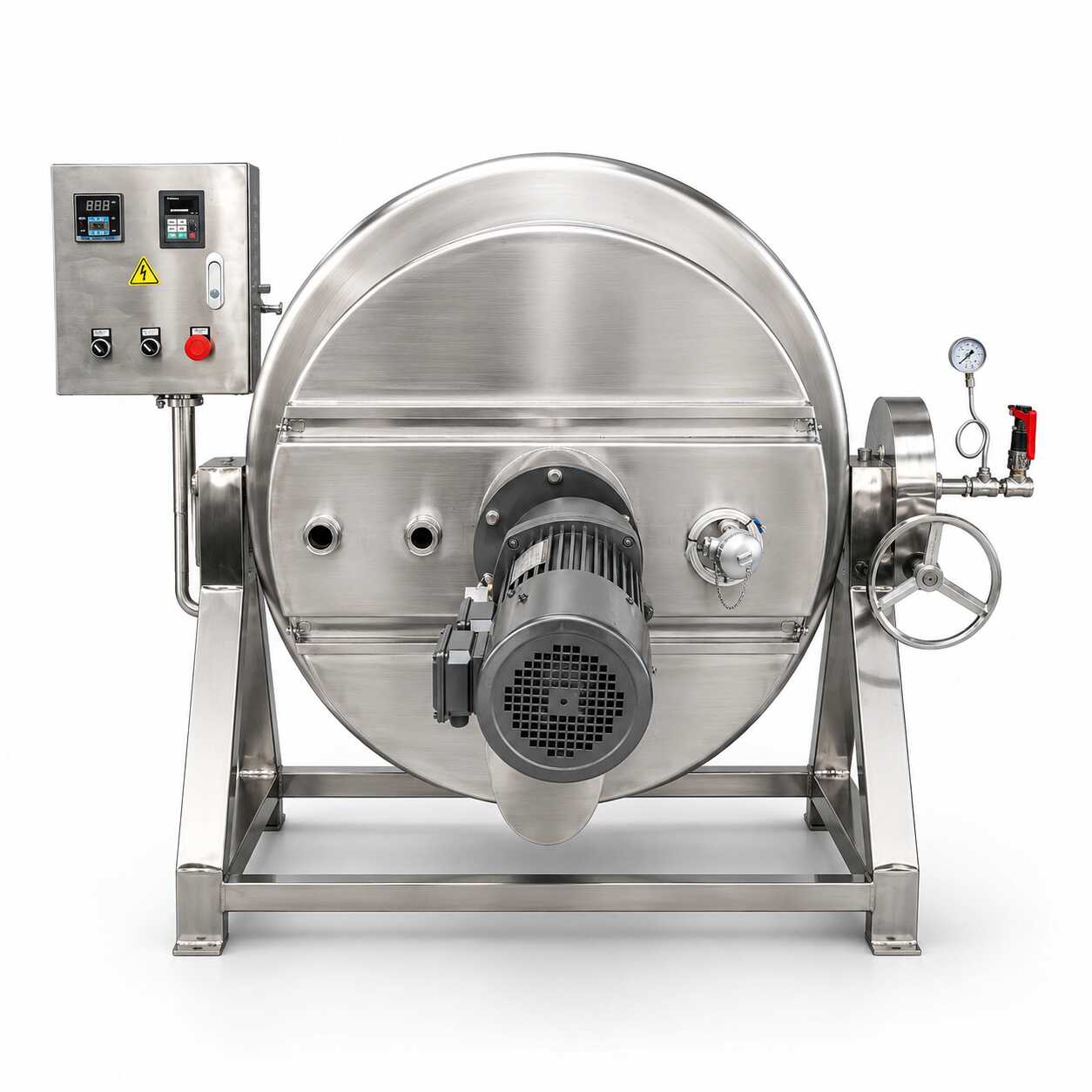
Sanitary construction in stainless steel 304 or 316L
The kettle is manufactured in stainless steel 304 or 316L, depending on the product, the expected level of corrosion, and the required hygienic standard. For common foods, 304 is usually sufficient. For products with salt, organic acids, chlorinated ingredients, aggressive cosmetic formulas, or frequent chemical cleaning, 316L offers a safer service life.
Practical differences between 304 and 316L
- Stainless steel 304: suitable for most food processes, good mechanical resistance, and more affordable cost.
- Stainless steel 316L: better resistance to corrosion from chlorides and acids; recommended when the equipment will work with demanding formulations or intensive CIP cycles.
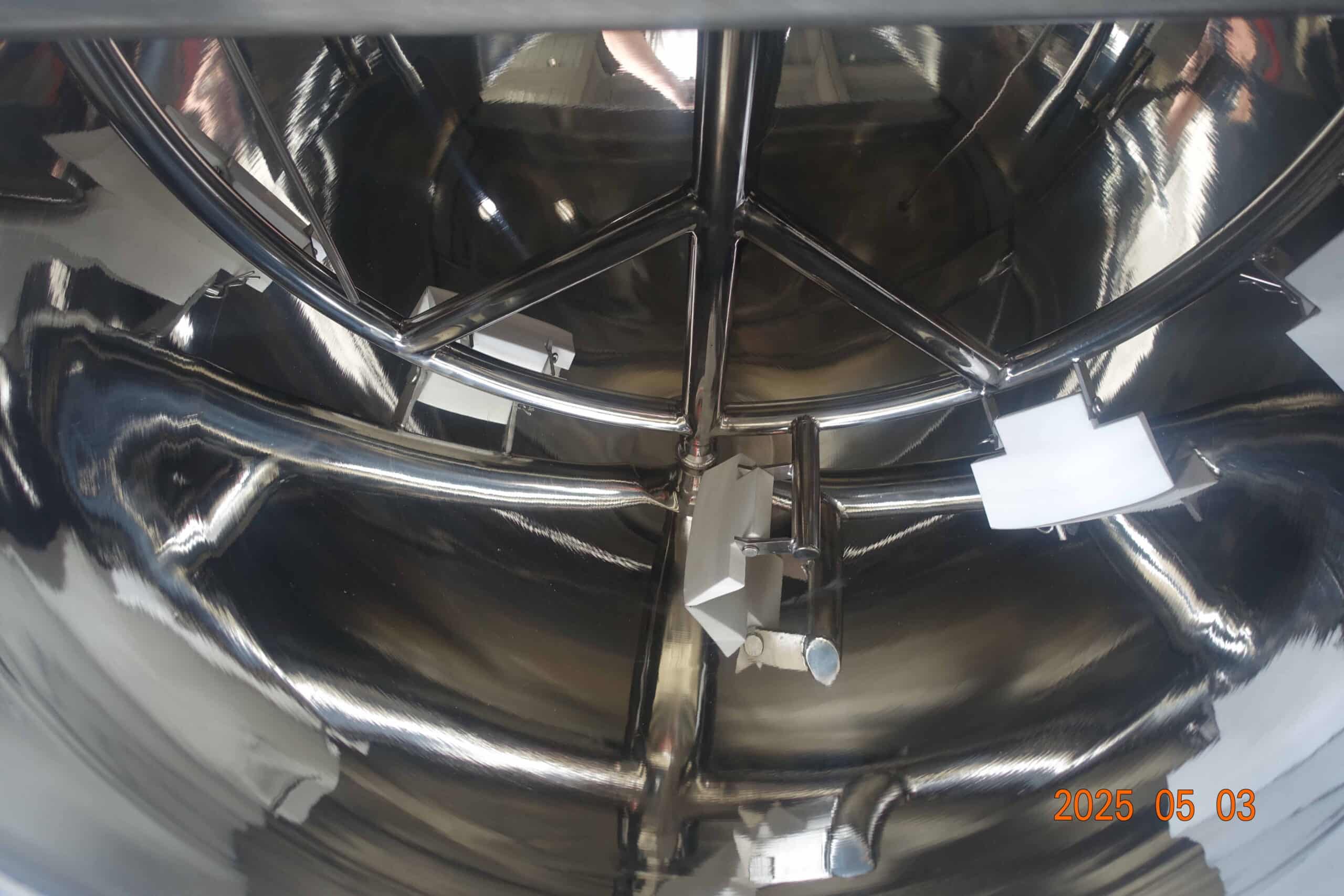
- Internal finish: must be smooth, without dead zones, and with polished welds, because accumulated residues ultimately affect cleaning, flavor, color, and product safety.
A cheap purchase can be costly if the material does not correspond to the actual process. I have seen 304 kettles work for years without problems in sweet sauces, and also equipment prematurely pitted due to use with hot brines. Steel is not chosen from a catalog. It is chosen based on chemistry, temperature, and cleaning.
Capacidades disponibles: de 50 a 1.000 litros
Common capacities range from 50 liters to 1,000 liters. The choice should not be based solely on the recipe volume. One must consider free space for agitation, thermal expansion, foam formation, and available time per shift.
Capacity selection criteria
- Actual useful batch volume, not just the nominal tank volume.
- Product density and viscosity.
- Required heating time.
- Frequency of loading and unloading during the workday.
- Availability of steam, gas, or electrical power in the plant.
- Space for cleaning, maintenance, and safe operation.
A 500-liter kettle does not always produce twice as much as a 250-liter one. If the available heating is insufficient, the large batch may take too long and disrupt the production balance. This is a common mistake: buying volume without verifying installed energy.
Heating options: steam, electric, and gas
The equipment can be configured with steam, electric, or gas heating. Each option has clear advantages but also compromises that should be understood before purchasing.
Steam heating
Steam heating is the most stable option for continuous or semi-industrial production. It allows good heat transfer, uniform control, and rapid temperature recovery after loading. It is especially useful when the plant already has a boiler and steam network.
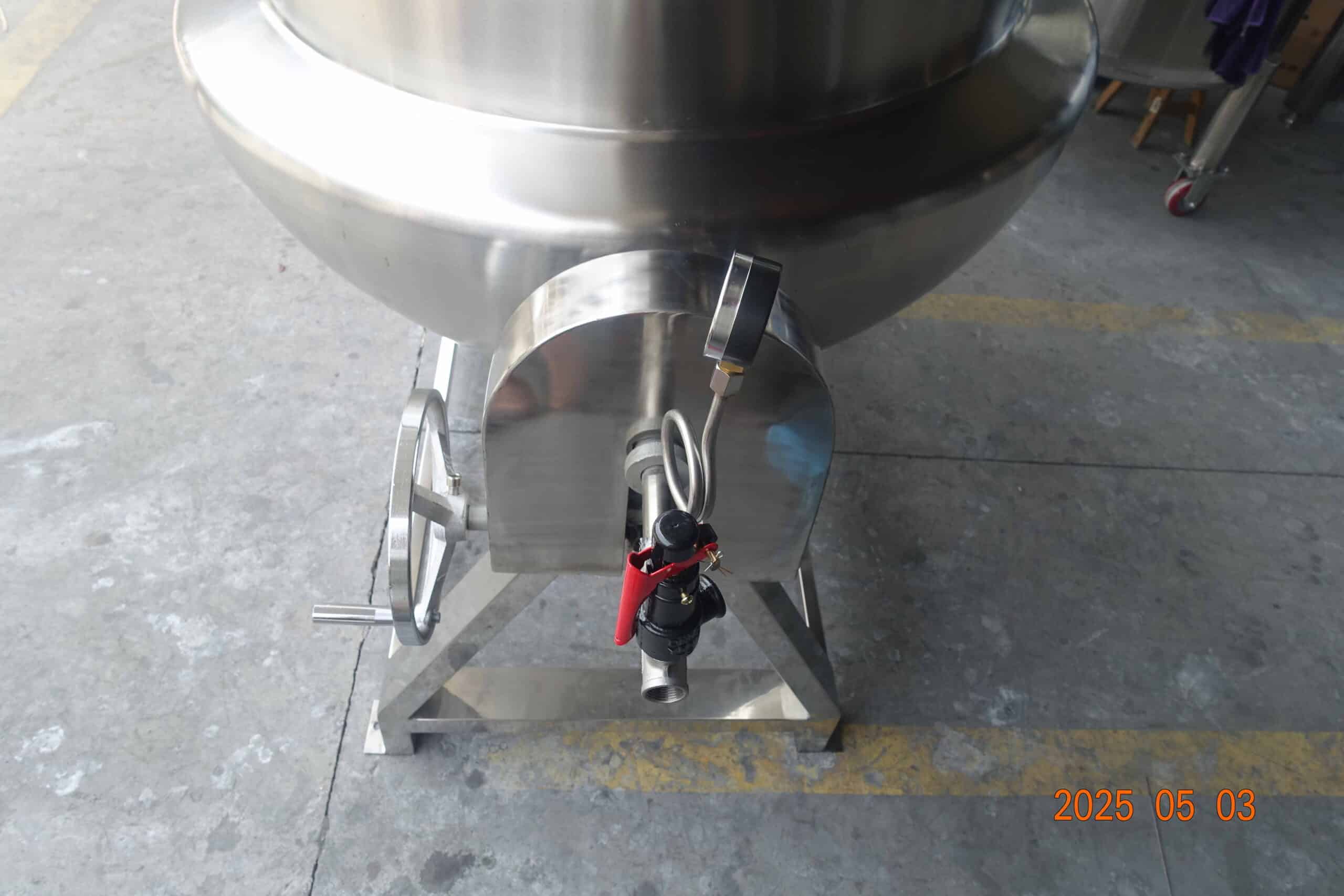
The critical point lies in the quality of the steam, condensate drainage, and sizing of traps. A jacket filled with condensate heats poorly. It also causes water hammer if the installation is poorly designed. In actual operation, many problems attributed to the kettle come from the steam line, not the tank.
Electric heating
The electric version is clean, compact, and easy to install in small plants, pilot laboratories, or rooms without a boiler. It offers good control but depends on the available power. For high-viscosity products or large capacities, heating time may be longer if the resistors are undersized.
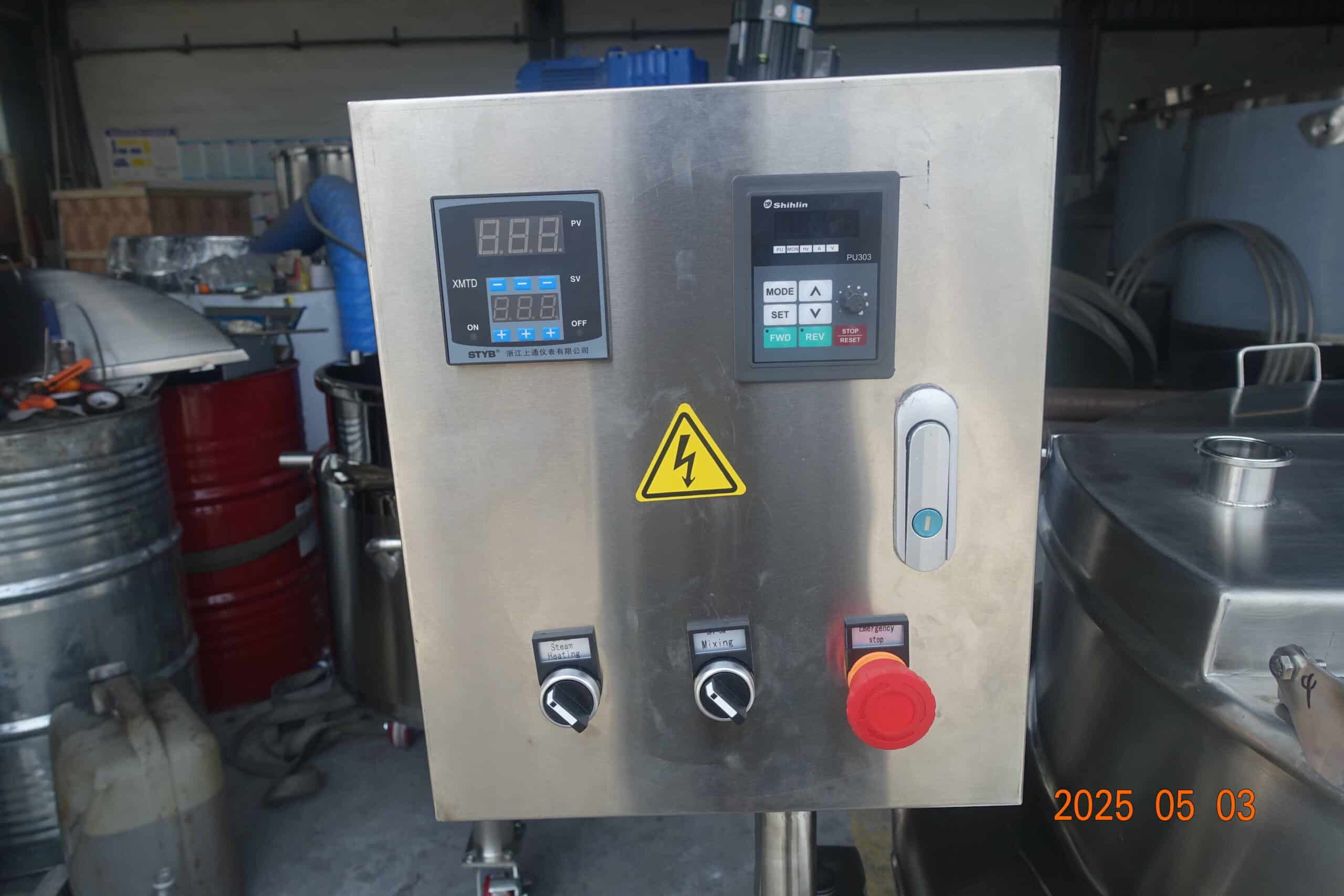
It is advisable to review the total electrical load, protections, type of panel, sensors, and ease of resistor replacement. In maintenance, a burnt resistor is easy to replace if the design allows access. Otherwise, it results in unnecessarily long downtime.
Gas heating
Gas can be convenient when independence from a boiler is needed and the energy tariff is favorable. It is common in medium-sized plants or larger-scale industrial kitchens. Its disadvantage is that thermal control is usually less precise than with steam or electricity, especially for delicate products.
It also requires good ventilation, properly calibrated burners, and periodic safety inspections. Poor combustion not only wastes energy; it can cause uneven heating and affect the lifespan of the bottom or thermal jacket.
Common industrial applications
The industrial steam kettle is used in processes where heating, cooking, concentrating, dissolving, or mixing with controlled temperature is required. Depending on the product, it can include a central agitator, scrapers, hinged lid, tilting system, bottom discharge, sanitary valves, automatic temperature control, and thermal insulation.
Common uses in production
- Cooking sauces, broths, soups, and fillings.
- Preparation of jams, syrups, candies, and sugar mixtures.
- Dairy processes such as creams, bases, and non-aseptic pasteurized mixtures.
- Dissolution of powders, stabilizers, gelling agents, and additives.
- Manufacture of cosmetic creams, lotions, and simple emulsions.
- Heating of chemical solutions compatible with stainless steel.
When the product sticks, crystallizes, or forms a film, the agitator design is as important as the heat source. A kettle without scrapers may work well for broths but not for dulce de leche, dense sauces, or creams with solids. Not everything is solved by increasing the temperature.
Technical details affecting performance
Heating jacket and heat transfer
The jacket must distribute heat evenly. In steam equipment, the design should favor steam entry, air exit, and efficient condensate drainage. In electric or gas equipment, the priority is to avoid localized high-temperature zones.
Heat transfer depends on several factors: contact surface, vapor pressure, material thickness, product viscosity, agitation speed, and load level. In the plant, a recipe may perform well at 100 liters and become slow or unstable at 500 liters. Scaling is never automatic.
Agitation and product control
The agitator should be selected based on viscosity, shear sensitivity, and presence of solids. For light liquids, simple agitation may be sufficient. For thick products, it is advisable to use reinforced paddles, anchor, or a system with wall scrapers.
- An agitator that is too slow generates thermal stratification.
- An overly aggressive agitator can break texture or incorporate air.
- Scrapers reduce adhesion but require adjustment and maintenance.
- The speed variator helps when a recipe changes viscosity during cooking.
Common operational problems
A well-made kettle can yield poor results if installed or operated without criteria. The most frequent problems are not always visible at the start.
Slow heating
This may be due to low vapor pressure, undersized resistors, poorly regulated burner, poor insulation, or excessive load. It also occurs when the product is more viscous than expected and agitation does not properly renew the transfer surface.
Burnt or adhered product
It usually appears due to lack of agitation, excessive temperature, hot spots, or absence of scrapers. In products with sugar, milk, starch, or proteins, a few minutes of neglect are enough to ruin the batch.
Condensate in the jacket
In steam equipment, poorly drained condensate reduces efficiency and causes water hammer. The steam trap must be properly sized and kept clean. It is a small component but has a significant impact.
Incomplete cleaning
Corners, valves, gaskets, and agitator shaft are usually critical points. When residues remain, odors, cross-contamination, and variations in color or flavor appear. In cosmetics, emulsions can also break due to residues from the previous batch.
Equipment maintenance and service life
Maintenance of an industrial kettle should not be limited to repairing when it fails. A basic routine prevents long stoppages and protects the investment.
Maintenance recommendations
- Periodically check welds, gaskets, valves, and steam connections.
- Clean the interior immediately after the batch, before the product dries.
- Check the condition of scrapers, shaft seals, and agitator bearings.
- Check temperature sensors and calibrate them if the process requires precision.
- Inspect electric resistors, burners, or steam traps according to the type of heating.
- Avoid using carbon steel tools during cleaning to prevent contamination of the stainless surface.
Stainless steel can also be damaged. Excess chlorine, inadequate rinsing, or products left overnight can initiate corrosion. 316L resists more, but it is not indestructible.
Common misconceptions when buying a kettle
“More capacity always means more production”
Not necessarily. Production depends on the complete cycle: loading, heating, cooking, mixing, unloading, and cleaning. If unloading is slow or cleaning takes too long, a large kettle can become a bottleneck.
“Steam is always the best option”
Steam is excellent when the installation is well designed. But if there is no boiler, if pressure fluctuates, or if condensate drainage is poor, an electric or gas solution may be more practical for certain volumes.
“All stainless steel kettles are the same”
They are not. They change the steel grade, thickness, sanitary finish, welding quality, jacket design, agitator, valves, and ease of maintenance. Two pieces of equipment may look similar and behave very differently in production.
“Temperature control solves everything”
The controller measures at one point. The actual product may have hotter or colder zones if agitation is inadequate. In viscous processes, the indicated temperature does not always represent the entire batch.
Recommended selection according to plant type
For pilot production or small batches, a kettle of 50 to 150 liters with electric heating may be sufficient, especially if flexibility and low installation cost are required. For regular food production, models from 200 to 500 liters with steam usually offer a good balance between performance, control, and energy consumption.
In higher volume lines, from 600 to 1,000 liters, it is essential to review available energy, cycle time, unloading method, ingredient loading, and cleaning system. At that size, specification errors cost more. Much more.
Technical Conclusion
A well-selected industrial steam kettle improves process stability, reduces product losses, and facilitates thermal control in repetitive batches. The key is to adapt the equipment to the actual product: viscosity, composition, working temperature, cleaning regime, and plant energy capacity.
It is not advisable to buy based solely on liters or price. It is advisable to buy based on the process.